 Phuket Boat Tours
Best Time for Boat Trips in Phuket: Month by Month
November through April is the best time for boat trips in Phuket, when the south-west monsoon has cleared out and the Andaman Sea runs calm under mostly dry skies. May through October is the low season, when one operator's own listing calls the Phi Phi crossing very bumpy and recommends it only for travelers comfortable with rough seas. Neither window rules boat trips out entirely; what changes is which circuit makes sense, how the boat rides, and whether Maya Bay itself is even open. The month-by-month detail below covers all of it, in Celsius with Fahrenheit alongside.
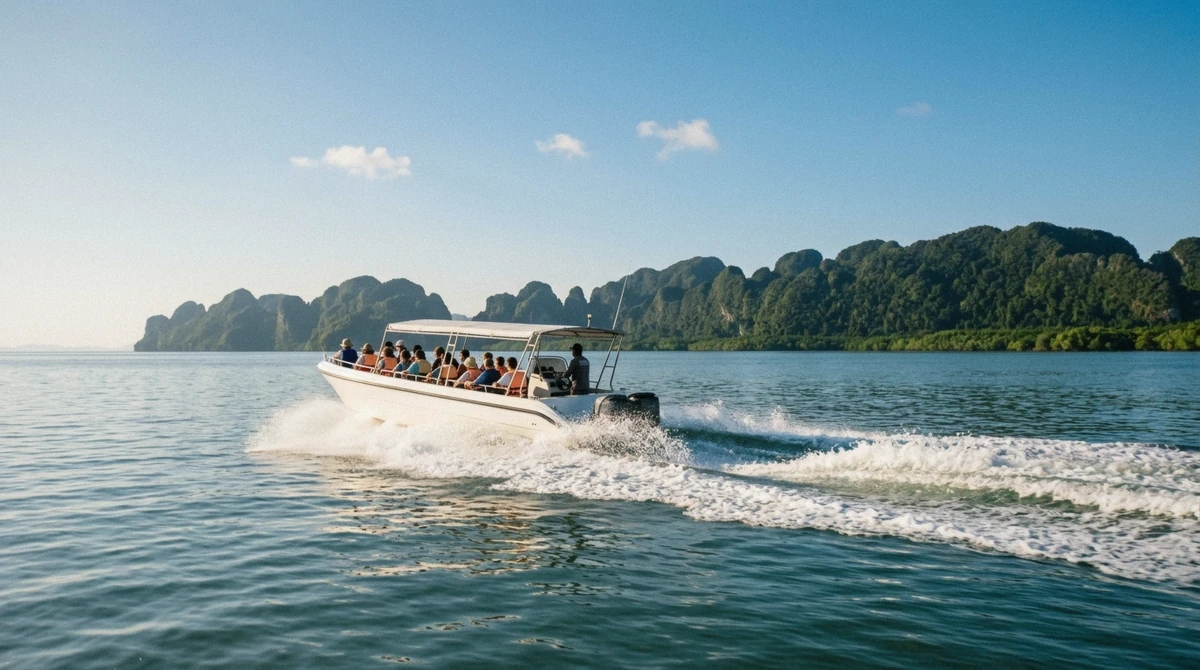
Quick answer November to April is calm and clear; June through October gets genuinely bumpy on the open-sea crossings
November through April is the best window for Phuket boat trips, when the south-west monsoon has passed and the Andaman Sea runs calm. May through October is low season, when one operator states in writing that the Phi Phi crossing gets very bumpy, though sheltered Phang Nga Bay keeps running through most of it.
Key takeaways
- High season runs November to April, with the calmest seas and the clearest skies; see the seasons at a glance
- One operator's own listing calls the June to October crossing very bumpy and recommends it only for travelers comfortable with rough water
- Maya Bay closes 1 August to 30 September every year regardless of sea conditions
- Phang Nga Bay stays calmer through low season than the open-sea Phi Phi crossing, since its islands shelter the water
- If a departure gets rebooked for weather, here's what actually happens to your booking
- Every boat tours from Phuket compared here runs a morning departure except the sunset cruise
Seasons at a Glance
Read the Verdict column first; it is the short answer for that month, and the table underneath it fills in the reasoning.
Month by month
Typical conditions for Mueang Phuket, drawn from Thai Meteorological Department normals and the tours' own seasonal notes.
| Month | Sea state | Weather | Crowds | Verdict |
|---|---|---|---|---|
| January | Calm | Dry, sunny | High | Best overall |
| February | Calm | Driest month | High | Best overall |
| March | Mostly calm | Warming, drier | Moderate | Good value |
| April | Mostly calm | Hot, brief showers | Moderate | Good, hotter |
| May | Building swell | Monsoon onset | Moderate | Shoulder, watch forecast |
| June | Rougher | Wet, humid | Low | Bumpy on open crossings |
| July | Rougher | Wet, humid | Low | Bumpy on open crossings |
| August | Rougher | Wettest stretch begins | Low | Maya Bay closed |
| September | Roughest | Wettest month | Low | Maya Bay closed, avoid if flexible |
| October | Improving | Rain tapering | Low to moderate | Shoulder, reopening month |
| November | Calm returning | Drying out | Moderate | Good value, calming seas |
| December | Calm | Dry, peak crowds | Peak | Best overall, busiest |
The pattern in one line
Every verdict above traces back to one physical driver, the south-west monsoon, which runs roughly May to October along the Andaman coast and reverses to give November through April its calm, dry character. Read that as a spectrum rather than a hard switch: late April and early November both sit in the transition and can go either way on a given week.
Temperature and Rainfall Month by Month
Thai Meteorological Department normals, 1981 to 2010
Typical daily maximum and monthly rainfall for Mueang Phuket. Figures are normals, not a forecast for any specific date; check the Thai Meteorological Department forecast close to your travel dates.
| Month | High °C (°F) | Rainfall (mm) |
|---|---|---|
| January | 32.7°C (91°F) | 30.3 |
| February | 33.6°C (92°F) | 23.9 |
| March | 34.0°C (93°F) | 73.5 |
| April | 33.9°C (93°F) | 142.9 |
| May | 32.8°C (91°F) | 259.5 |
| June | 32.4°C (90°F) | 213.3 |
| July | 32.0°C (90°F) | 258.2 |
| August | 32.0°C (90°F) | 286.8 |
| September | 31.5°C (89°F) | 361.2 |
| October | 31.5°C (89°F) | 320.1 |
| November | 31.7°C (89°F) | 177.4 |
| December | 31.7°C (89°F) | 72.4 |
Reading the numbers
Temperature barely moves across the year, staying within about two and a half degrees Celsius of its 34.0°C March peak all twelve months; rainfall is where the real swing sits, from 23.9 millimeters in February to 361.2 millimeters in September, a fifteen-fold difference. September is the wettest month by a wide margin and the coldest by the small margin this climate allows; February is both the driest and among the hottest.
Best Season by Traveler Type
If You want the calmest possible crossing and don't mind the crowds
Book December through February. Seas are at their calmest and skies at their clearest, though this is also when boats and piers are busiest
If You're traveling with young children or anyone prone to seasickness
Stay in the November to April window and lean toward Phang Nga Bay, whose short, sheltered crossing runs calmer than the open-sea Phi Phi route
If You want a quieter version of the same tours without rough seas
November or April, the shoulder months either side of peak season, still deliver settled weather with fewer boats stacked at the piers
If Your dates fall in June through September and can't move
Book a Phang Nga Bay tour rather than a Phi Phi one, and expect that Maya Bay is either skipped or closed outright in August and September
If You're chasing the lowest price and can tolerate a rougher ride
Low season, roughly June through September, generally means thinner crowds and more availability, at the cost of the bumpiest crossings of the year
High Season, November to April: Calm Seas, Clear Skies
The reliable window
November through April is when the Andaman settles into its calmest, clearest stretch, daily highs holding steady around 31.5 to 34.0°C (89 to 93°F) and rainfall dropping to a fraction of the wet-season totals, from 177.4 millimeters in November down to 23.9 millimeters in February. Crowds build steadily through the window and peak in December, when piers and popular stops run at their busiest. Book departures at least a few days ahead in December and January; earlier months in the window have more flexibility.
February stands out on the numbers alone: the driest month of the year at 23.9 millimeters of rain and among the hottest at 33.6°C (92°F), which is why travel agents across the island treat it as the safest single month to promise a client a rain-free boat day.
- Daily highs: 31.5 to 34.0°C (89 to 93°F)
- Crowds: moderate in November, peak in December and January
- Price signal: fares themselves don't vary by season on the listings compared here, but availability tightens in December
- Booking lead time: a few days ahead is safest in December; more flexible earlier in the window
Where it earns its reputation
This is the window every Maya Bay photograph you've seen was almost certainly taken in. Calm water means the Sea Angel speedboat's Loh Samah approach runs smoothly and the swim stops at Pileh Lagoon and Khai Island stay open without the current closures that can happen in rougher months.
The trade-off nobody advertises
The cost of that reliability is that everyone else books it too. December's combination of dry weather, calm seas and holiday travel produces the fullest boats and the busiest piers of the year; check-in queues run longer and popular photo spots like the Pileh Lagoon overlook carry more boats stacked at once than the same stop would see in October. Travelers who value an uncrowded photograph over the statistically calmest water sometimes do better booking the edges of this window, November or late February to March, rather than its December to January core.
The Shoulder Months: April, May, October, November
Transition, not a clean switch
The monsoon does not flip on a single date; late April into May and October into November are genuine transition windows where a calm week and a rough one can sit back to back. April holds onto high-season temperatures, 33.9°C (93°F), with rain still low at 142.9 millimeters, making it a reasonable bet for travelers who want fewer crowds than December without gambling on the wettest months. October is the mirror image on the other side of the monsoon, rainfall still elevated at 320.1 millimeters but visibly tapering from September's peak.
- April: hot, still mostly dry, thinner crowds than peak season
- May: monsoon onset, swell building through the month
- October: rain tapering, Maya Bay reopens on 1 October
- November: seas calming, a good-value window before December's peak
The tour that works well here
The 7 Wonders Phang Nga Bay tour runs its full six-island circuit through the shoulder months without the itinerary changes that some Phi Phi operators apply from May onward, since Phang Nga's sheltered water is less sensitive to the early stages of the monsoon buildup.
Low Season, May to October: Rougher Water, Thinner Crowds
What actually changes
One operator's listing states the trade-off plainly: "Low Season (Jun-Oct): Recommended for guests comfortable with rough seas, as the boat ride is very bumpy," and adds that itineraries from May through September may be adjusted for weather. That is the most direct, sourced description of low-season conditions across the listings compared here, and it applies most sharply to the open-water Phi Phi crossing rather than to Phang Nga Bay.
- Daily highs stay warm, 31.5 to 32.8°C (89 to 91°F), barely below high season
- Rainfall peaks at 361.2 millimeters in September, the wettest month of the year
- Crowds thin noticeably from June onward; piers and popular stops run quieter
- Maya Bay closes outright 1 August to 30 September, separate from any weather effect
The tour built for this window
The James Bond Island sunset cruise runs Phang Nga Bay's sheltered water rather than the open Phi Phi crossing, which keeps it a more consistent low-season booking than the Phi Phi tours whose operators warn about rough seas in the same months.
What low season actually buys you
Set against the rougher water, low season has real upsides beyond price. Fewer boats means shorter queues at check-in, more breathing room at stops like Khai Island and Monkey Beach, and a noticeably different feel at spots that get genuinely packed in December. Rainfall, even at its September peak of 361.2 millimeters, tends to arrive as short, heavy downpours rather than an all-day soak, so a wet forecast rarely means a washed-out day; it more often means a squall passing through while the boat continues on schedule.
What Actually Decides Whether a Boat Runs
Wind and swell, not rain on your shoulders
The counterintuitive fact worth knowing before you book: a wet forecast rarely cancels a Phuket boat trip by itself. Boats sail through light rain routinely, since a tropical downpour that passes in twenty minutes doesn't change sea state much. What actually stops or reroutes a departure is wind and the swell it builds, particularly on the open-water stretch between Phuket and Phi Phi Leh, roughly an hour of exposed sea compared with the sheltered 30 to 45 minute crossing into Phang Nga Bay.
That difference in exposure is the real reason Phang Nga Bay tours keep running more consistently through low season while Phi Phi departures get adjusted or, at extremes, cancelled.
Why the geography matters more than the calendar
Phang Nga Bay sits mostly inside a ring of limestone islands that break up incoming swell before it reaches the boat, which is why its crossing stays a manageable 30 to 45 minutes even when the open sea outside is running rougher. The Phi Phi route has no such shelter for most of its roughly hour-long crossing, so the same wind that barely registers in Phang Nga Bay can turn the Phi Phi run into the very bumpy ride one operator warns about. That single geographic fact, sheltered bay versus open crossing, explains most of the seasonal difference in how each circuit rides, more than the rain totals in the table above.
What Closes and When
Two closures on two different calendars
Maya Bay closes to landings every year from 1 August through 30 September, a fixed reef-recovery window that applies regardless of that particular week's weather; the full rules and reopening date are covered on our dedicated guide. Mu Ko Similan National Park, further north and not covered by the tours compared on this site, closes for the entire monsoon, roughly 16 May through 15 October, and charges 500 THB per adult when open. Neither closure is a weather call made day to day; both are fixed calendar windows set well in advance.
Travelers planning a trip around a specific closure date should build in a buffer day either side, since a 1 October reopening is a park decision that can shift slightly year to year even when it has held reliably in recent seasons.

Best Time of Day
Morning departures, and why
Every tour compared here departs in the morning, and that's not incidental: winds and afternoon thunderstorm activity both tend to build later in the day, so an early start generally means calmer water at the first stops and a better chance of finishing before an afternoon squall rolls through. The one exception is the James Bond Island sunset cruise, which is built around an evening finish by design, timed for the dinner service and the sunset itself rather than around sea state.
If the Weather Turns
The short version
A stop can be skipped for rough water without the whole tour cancelling; a verified August 2026 review of one Phi Phi tour records Maya Bay being skipped for high waves while the rest of the day ran normally. All six tours offer free cancellation up to 24 hours before departure, and the 7 Wonders Phang Nga Bay tour additionally states a full refund if the tour itself is cancelled for storms, and that it otherwise runs normally in rain unless a severe weather warning is in force. Every operator also reserves the right to reorder or replace stops for weather, tide or safety, which is worth knowing before a low-season booking rather than after a rerouted itinerary.
The full mechanics of what happens to your booking, and which listings actually guarantee a refund versus a reschedule, are covered on what actually happens if your tour is cancelled for weather, which this section defers to rather than repeating.
So, When Should You Go?
The verdict
November through April remains the best window for a Phuket boat trip, calm water, clear skies and every stop running as scheduled, with December and January the peak of that reliability and also its most crowded weeks. April and November are the budget-conscious runner-up, trading a little of the peak-season polish for thinner crowds. September is the month to avoid if your dates are flexible at all: it is the wettest month on record, the roughest sea state of the year, and the one month Maya Bay is guaranteed closed.
Best Time Questions
What is the best time for boat trips in Phuket?
November through April, when the south-west monsoon has passed and the Andaman Sea runs calm and clear. December and January are the most reliable individual months, though also the busiest.
What months have the roughest seas in Phuket?
June through September, with September the roughest by rainfall and generally the least settled sea state of the year. One operator states the June to October crossing is very bumpy and recommends it only for guests comfortable with rough seas.
Can you take boat tours in Phuket during the rainy season?
Yes, particularly into Phang Nga Bay, whose sheltered, island-shielded water stays calmer than the open Phi Phi crossing through most of low season. Phi Phi tours still run too, just with rougher water and a higher chance of itinerary adjustments.
Is the morning or afternoon better for a Phuket boat tour?
Morning. Every tour compared here departs in the morning, since wind and afternoon storm activity both tend to build later in the day; the one exception is the James Bond Island sunset cruise, timed deliberately for an evening finish.
When is monsoon season in Phuket?
Roughly May through October along the Andaman coast, with the wettest stretch concentrated from August through October. Maya Bay's fixed 1 August to 30 September closure sits inside this window but is set by a separate reef-recovery calendar, not by the weather itself.
Which month is cheapest for a Phuket boat tour?
Listed fares on the tours compared here don't vary by season; what changes in low season is availability and crowd levels, which run noticeably thinner from June through September than in the December to January peak.
How far ahead should I book in high season versus low season?
A few days ahead is enough in most of the November to April window, but December and January departures fill faster and are worth booking earlier. Low-season months generally have more last-minute availability.
Whatever month lands on your itinerary, the boats compared here run through nearly all of it; the real question is which circuit suits the water on your dates, sheltered Phang Nga Bay through the rough months, either circuit once November settles the sea back down. Departure dates and live prices for each boat sit on the Phuket boat tour comparison page.